Chevron Parquet Flooring: Everything You Need to Know Before You Buy
A quiet revolution is happening in Irish homes.
Walk into any renovated kitchen in Dublin or step into a freshly fitted living room in Kildare or Wicklow, and chances are you’ll spot it immediately: that arrow-like pattern running across the floor, pulling the eye forward, and making a room feel longer, wider, and more considered.
Chevron flooring has become one of the most sought-after timber floor choices in Ireland, and it’s not hard to see why. It blends old-world craftsmanship with a modern sense of style. It works in period homes and contemporary builds alike. And done well, it transforms a floor from a background detail into the defining feature of a room.
At MM Parquet, we’ve been supplying and fitting premium timber floors across Dublin and Leinster for years. We work directly with homeowners, architects, and interior designers to source, advise on, and install chevron parquet floors to the highest standard.
Whether you’re renovating a Victorian terrace in Ranelagh or building a new home in Meath, this guide will walk you through everything you need to know about chevron parquet flooring before you buy.
What Is Chevron Flooring?
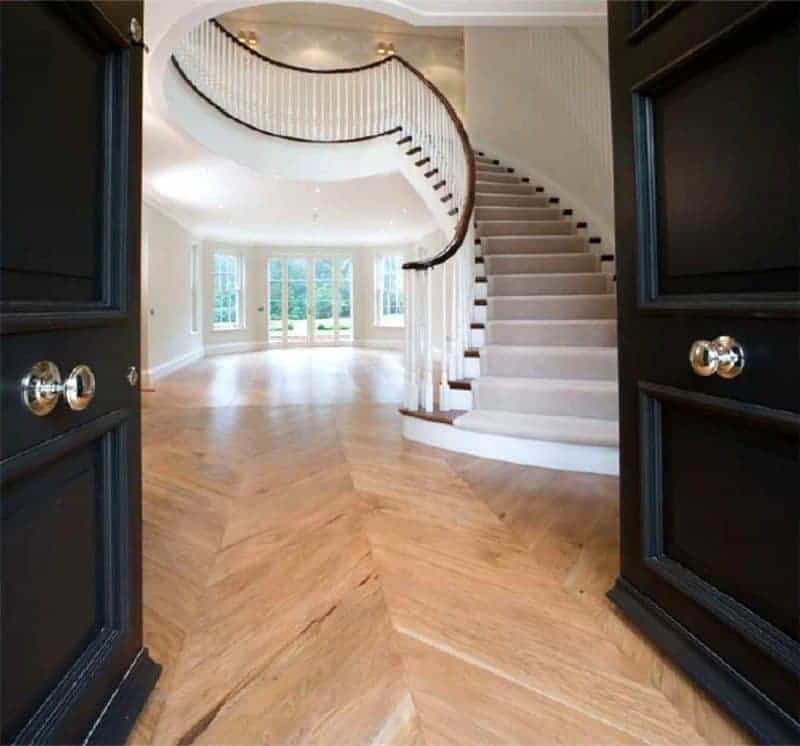
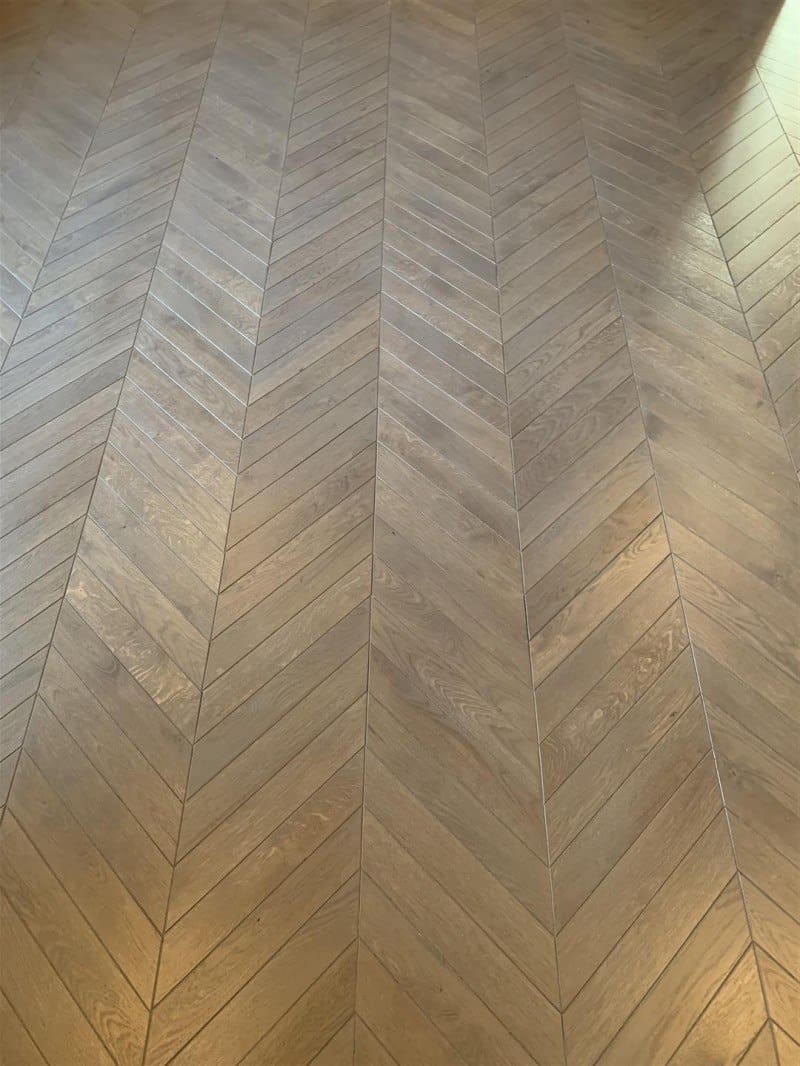
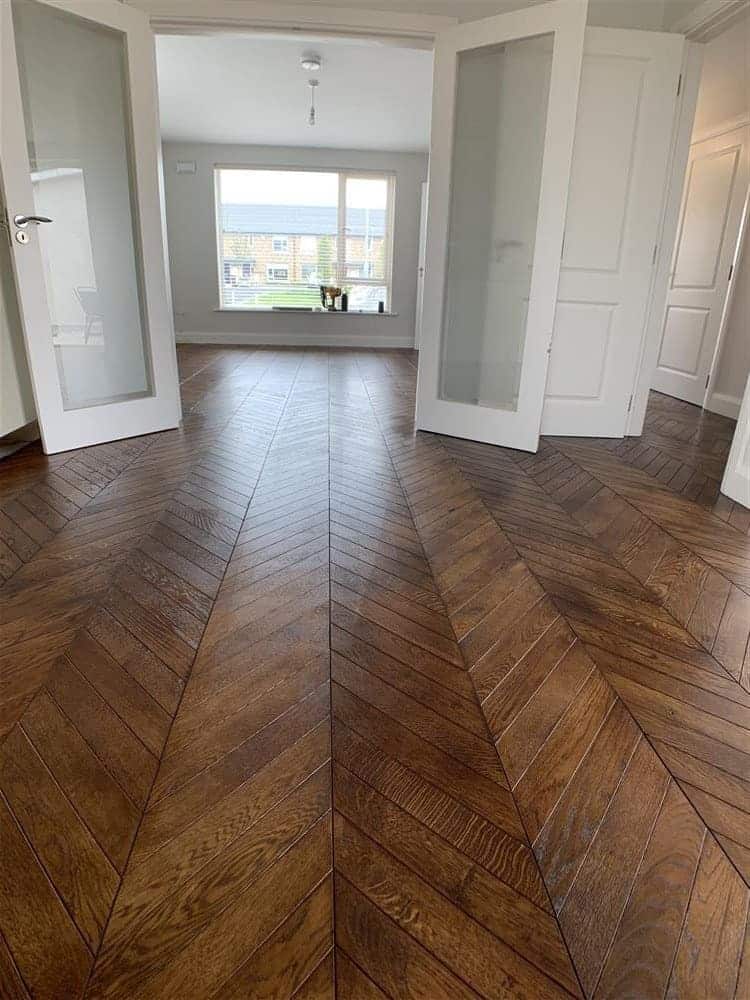
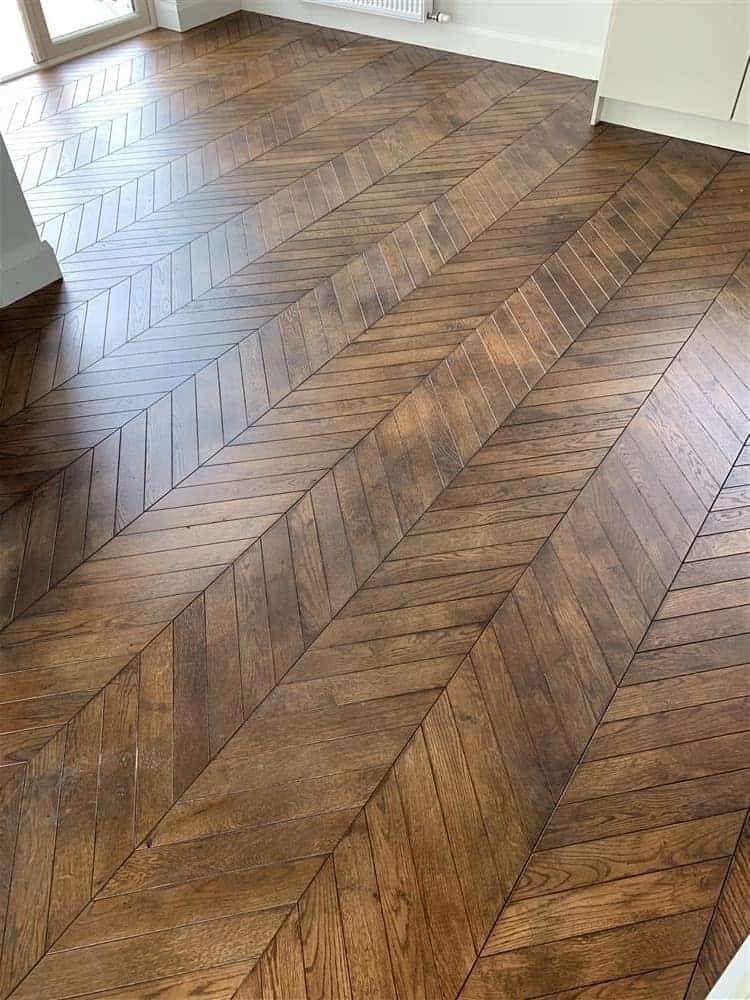
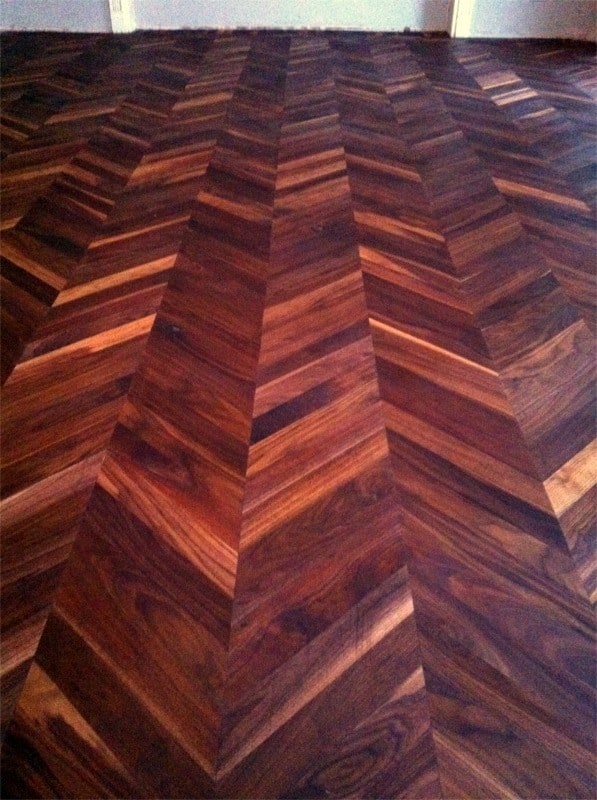
Chevron flooring is a type of parquet flooring made from individual timber planks that are cut at a precise 45-degree angle at each end. When laid, these angled ends meet perfectly at the centreline to create a continuous, seamless “V” or arrow pattern that runs the full length of the room.
That precision cut is what makes chevron-style flooring so distinctive and demanding to produce. Every board is purpose-cut, every joint is intentional, and the result is a floor with a visual rhythm that feels both bold and refined.Unlike strip flooring or wide-plank boards, which rely on the natural beauty of a single plank, chevron parquet flooring is about composition. The pattern does as much work as the wood itself. It’s this combination of material and geometry that places chevron firmly in the premium tier of timber flooring options.

Chevron vs Herringbone Floor: Key Differences
This is one of the most common questions we get at MM Parquet, and it’s a fair one. From a distance, chevron and herringbone can look similar. Both use rectangular timber blocks arranged in a zigzag. But once you know what to look for, the differences become clear.
The pattern itself is the clearest distinction. In herringbone, each plank is cut square at both ends and laid at 90 degrees to the next one, creating a staggered zigzag; think of it like brickwork on a diagonal. In chevron flooring, the planks are cut at 45 degrees and meet at a central point, forming a continuous “V” that points in one direction. Herringbone has a broken, tessellated quality; chevron has directional flow.

Visually, chevron feels more contemporary and dynamic. The unbroken arrow pattern draws the eye forward, which can make a room feel longer. Herringbone, with its offset joints, has a slightly more traditional or rustic feel. Both are timeless, but they suit different aesthetics.
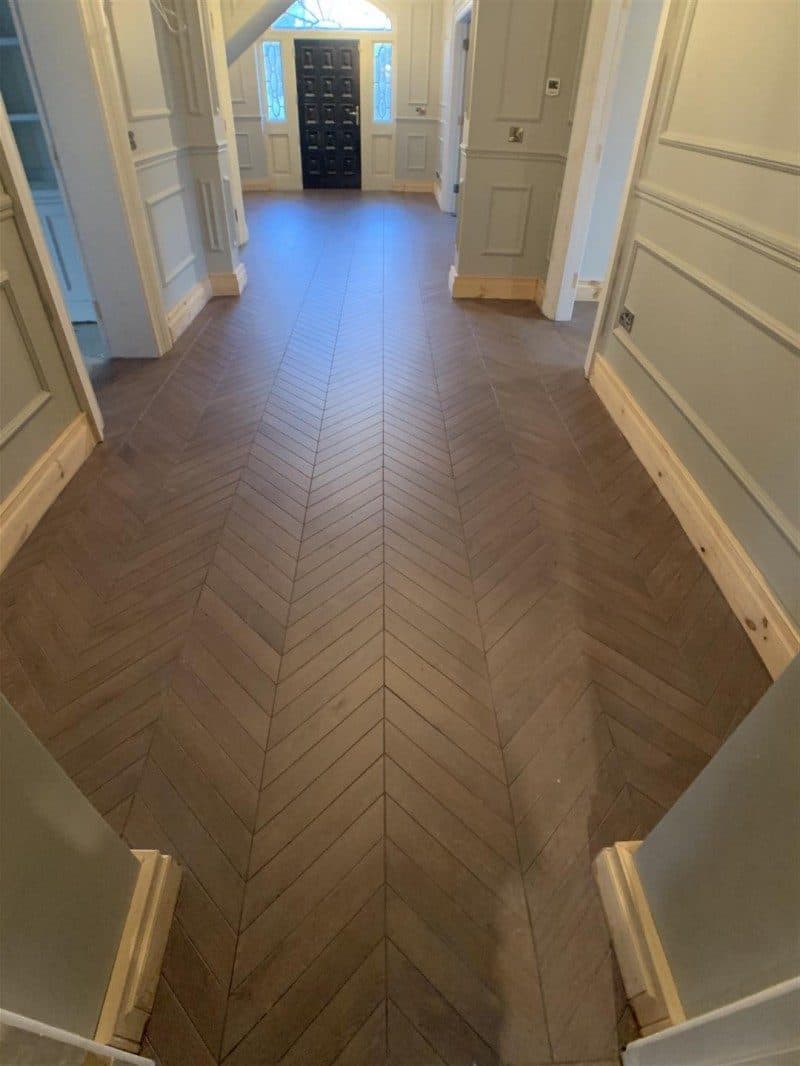
In terms of room size and shape, chevron works better in larger, open-plan spaces where the directional flow has room to breathe. It’s especially striking in hallways and kitchen-diners. Herringbone is a little more forgiving in compact rooms because its broken pattern doesn’t demand a specific orientation to look balanced.
Installation complexity is another key difference. Both require an experienced fitter, but chevron is considered the more demanding of the two. The angled end cuts must be precise; even a fraction of a degree off will cause gaps or misalignment that compound across the entire floor. It requires a specialist parquet installer who has worked with the pattern before.
Cost reflects this complexity. Chevron flooring has a slightly higher price point than herringbone, both in material (the angled cuts produce more waste) and in fitting labour. That said, the investment is well worth it. A well-laid chevron floor adds lasting value to a property.
Chevron Flooring in the Kitchen
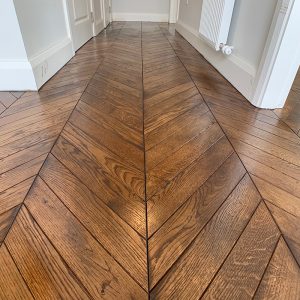
The kitchen is arguably the best room in the house to lay a chevron floor. Here’s why it works so well.
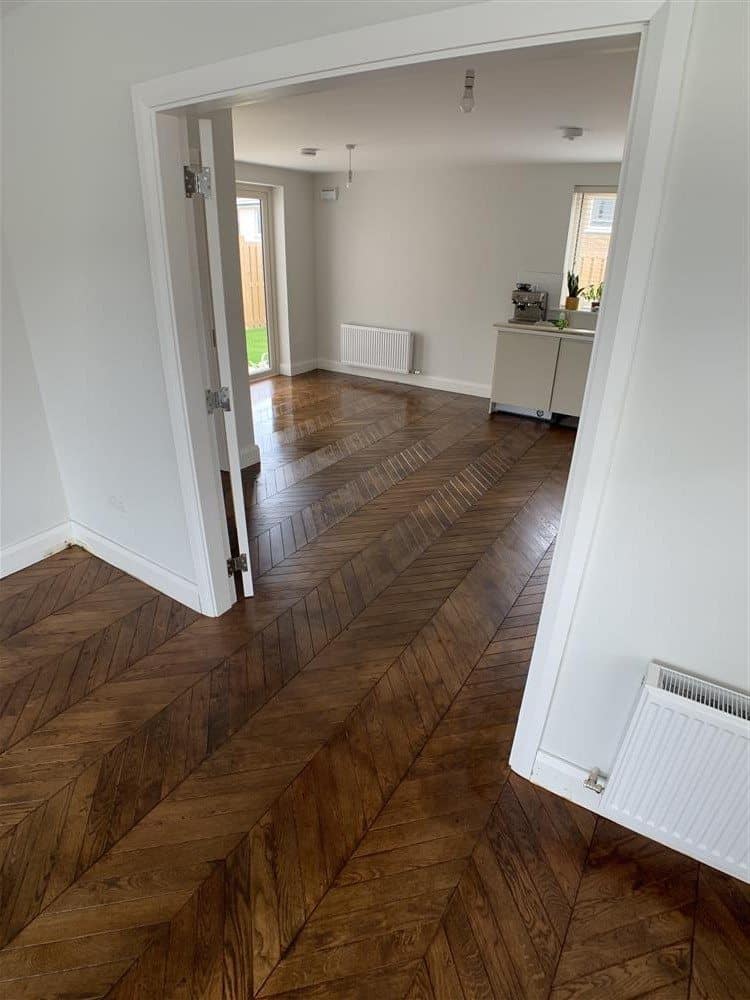
Kitchens are high-traffic, high-visibility spaces. The directional flow of the chevron gives a sense of movement and depth, which helps even modest-sized kitchens feel more spacious and connected to adjacent dining or living areas. Open-plan kitchen-diners benefit enormously from the pattern’s ability to unify a large floor area without it feeling monotonous.
For wood species in the kitchen, oak is the default choice (more on this below), but European ash and hard maple are also strong performers. You want a species with good hardness and dimensional stability because the kitchen environment sees fluctuations in both moisture and temperature. A more porous or reactive timber will show the effects over time.
Finishing is critical in a kitchen context. A hard-wax oil finish is a popular choice because it’s durable and gives a natural, matte appearance that suits both modern and traditional kitchens. UV-cured lacquer finishes offer greater surface hardness and are ideal for households with young children or pets. Avoid unfinished or lightly oiled floors in very high-moisture kitchen zones unless you’re confident about regular maintenance.
Chevron Oak Flooring: The Most Popular Choice
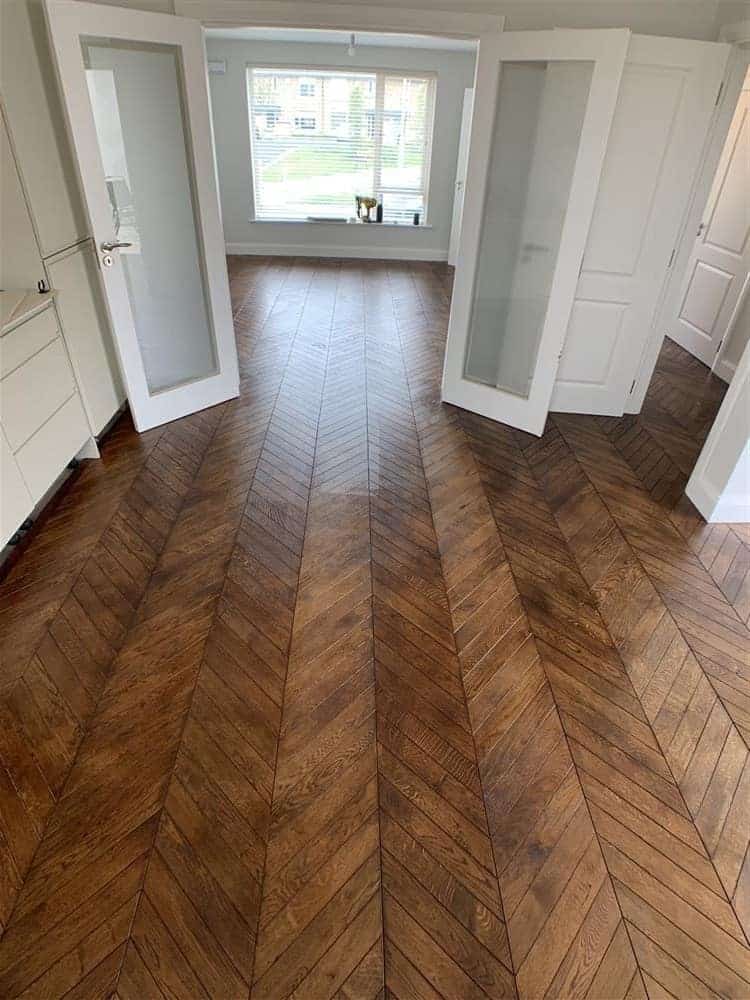
Ask any flooring specialist in Ireland what species dominates the chevron market, and the answer is almost always the same: oak. Specifically, European white oak has been the backbone of quality timber flooring in Ireland and across Europe for centuries.
Chevron oak flooring is popular for a number of reasons. Oak has excellent hardness. It resists denting and scratching far better than softer species like pine.
Its open grain takes stain beautifully, which means you can achieve any colour tone from pale blonde to deep espresso. And it has reliable dimensional stability, meaning it moves less with seasonal humidity changes than many other species.
From a design perspective, oak’s grain pattern adds visual interest without overwhelming the chevron pattern itself. The medullary rays catch the light in a way that makes a well-laid chevron floor look genuinely alive.
Finish options for chevron oak flooring range from natural unfinished (oiled on-site) to factory-finished in white, grey, smoked, or brushed textures. The availability of so many finishes and grades makes oak the most versatile choice for any room or interior style.
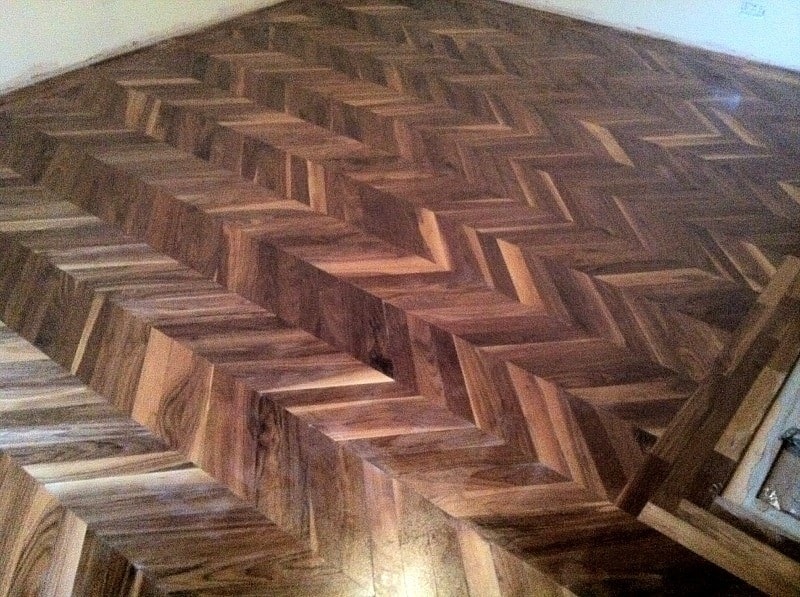
Dark Chevron Flooring
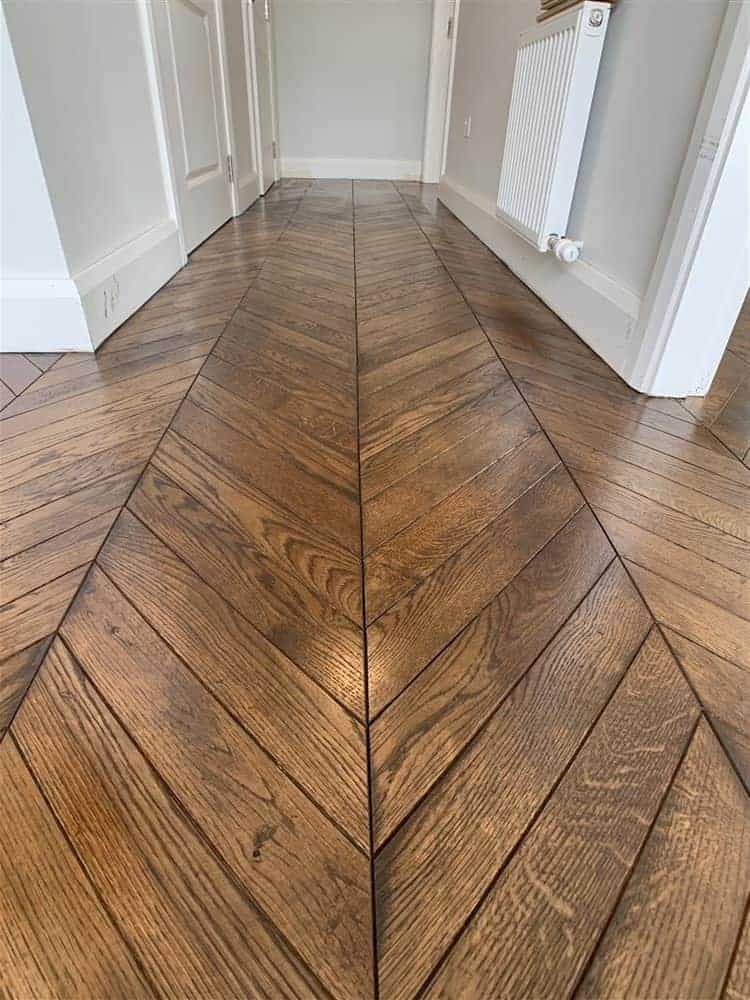
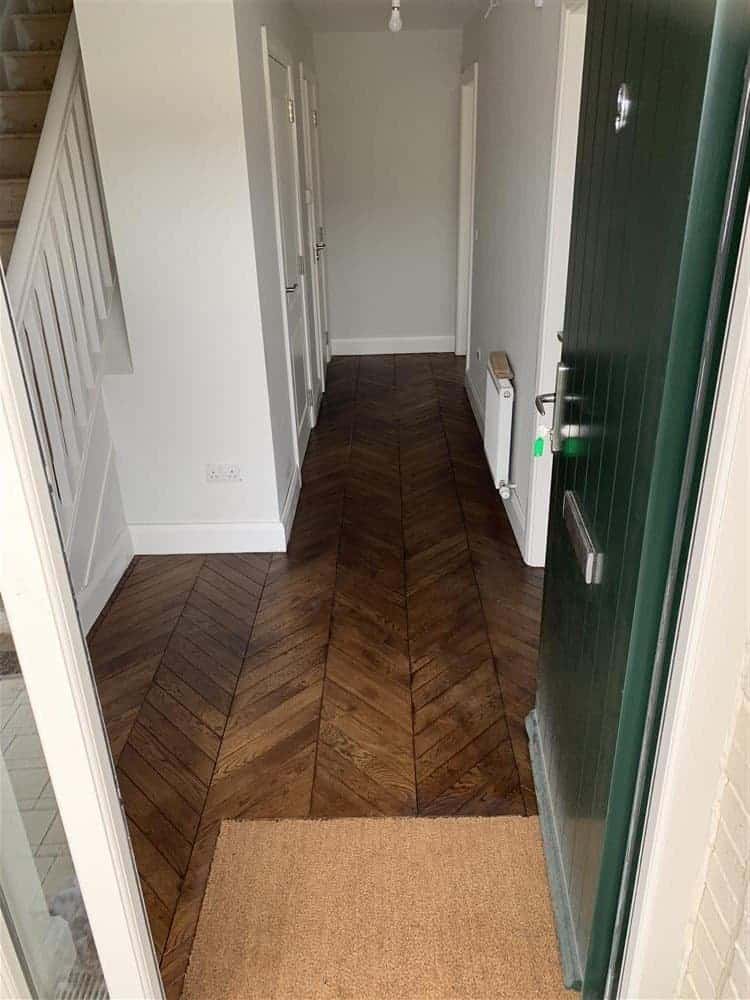
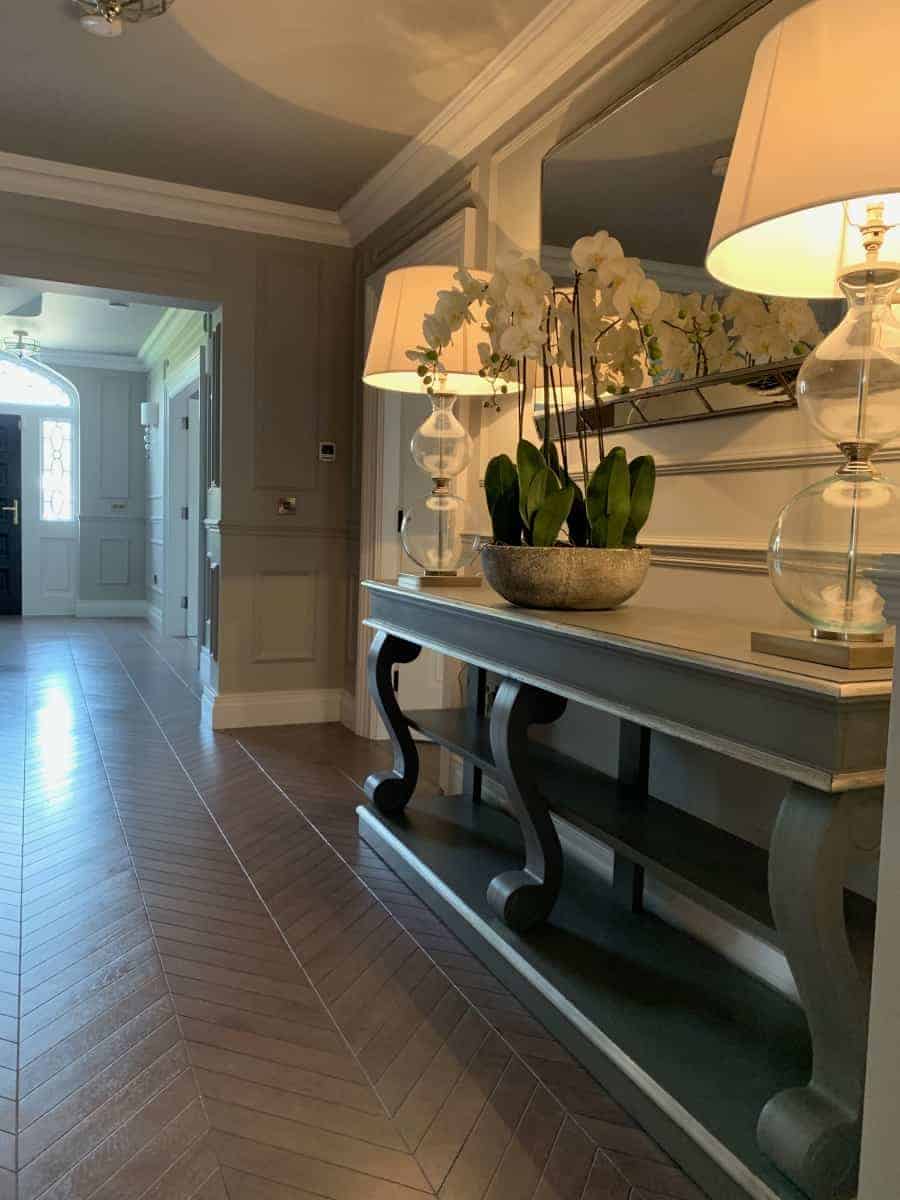
If oak in its natural blonde tone is the safe choice, dark chevron flooring is the bold one. In the right interior, a dark chevron floor is absolutely stunning.
The most popular species for dark tones are American black walnut, which offers a rich chocolate-brown colour with a smooth, tight grain; stained European oak, which can be taken to almost any dark shade using reactive stains or fuming techniques; and merbau, a dense tropical hardwood with a warm reddish-brown tone.
In Irish homes, dark chevron floors work well in living rooms and dining rooms where lower light levels and richer furnishings complement the depth of the floor. Paired with light walls, pale cabinetry, and natural linen textures, a dark chevron floor becomes the anchor of the room, and everything else orbits around it.
A few practical considerations: dark floors show dust, pet hair, and light scratches more readily than mid-tone or light floors. Regular maintenance, such as sweeping, occasional buffing, and re-oiling, is more important than with paler species.
That said, many homeowners find the trade-off worth it for the dramatic effect a dark floor delivers.
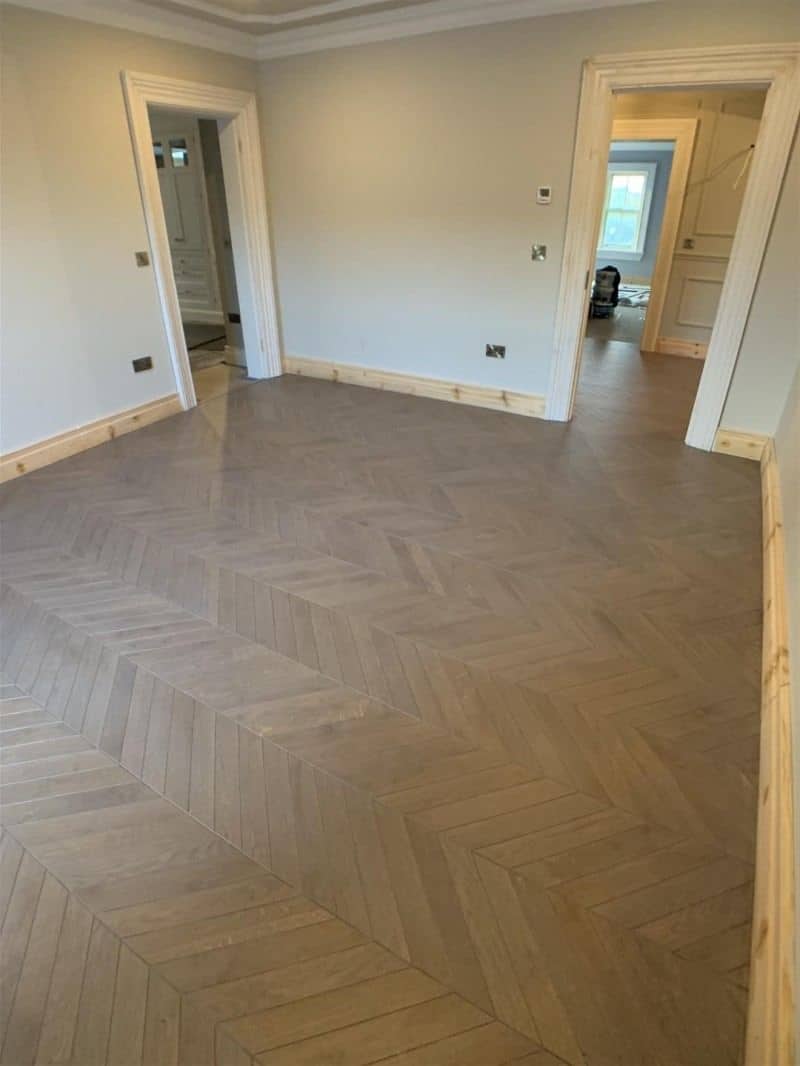
Grey Chevron Flooring
Grey chevron flooring has been one of the defining interior trends of the past decade, and it shows no sign of fading.
The cool, neutral tone sits beautifully with the white kitchen, the pale sofa, and the brushed nickel hardware. It’s the palette that dominates new-build homes and modern renovations across Dublin and Leinster.
Grey chevron flooring is achieved in several ways. Reactive staining (sometimes called fuming or smoke treatment) uses a chemical reaction with the tannins in oak to produce grey tones that penetrate deep into the wood. These floors age beautifully and don’t show wear in the same way a surface-applied colour does.
Pre-finished engineered boards are another option, with factory-applied grey stains available in dozens of shades from pale ash grey to deep slate.
The key to grey chevron flooring that looks intentional is picking the right tone for your light. Cool northern light (common in many Dublin homes) suits a blue-grey or ash grey. Warmer rooms with south-facing light can handle a more taupe or greige tone without looking cold.
Grey chevron floors pair exceptionally well with natural materials, like raw linen, rattan furniture, concrete worktops, and exposed brick. They also work well in more traditional interiors as a grounding neutral, tying together a palette of heritage greens, dusky pinks, and warm whites.
Solid vs Engineered Chevron Hardwood Floors
One of the most practical decisions you’ll make when choosing chevron hardwood floors is whether to go for solid or engineered. Both are genuine timber, but they behave differently and suit different situations.
Solid chevron timber flooring is a single piece of hardwood all the way through, usually 18–22mm thick. It’s the most traditional form of parquet flooring and can be sanded and refinished multiple times over its lifetime. The limitation is moisture sensitivity; solid timber expands and contracts with changes in humidity, which means it’s not ideal over underfloor heating or in rooms prone to moisture fluctuation.
Engineered chevron timber flooring has a real hardwood top layer bonded to a plywood or HDF core. The layered construction makes it more dimensionally stable than solid wood, which is why it’s the better choice for use with underfloor heating, which is a common feature in new Irish homes.
Engineered boards can still be sanded and refinished, though fewer times than solid, depending on the thickness of the wear layer (look for a minimum of 4–6mm for longevity).
For most installations in Ireland, engineered chevron flooring is the practical recommendation. The stability benefits, compatibility with heating systems, and near-identical appearance to solid make it the smarter long-term choice for the majority of homes.
Chevron Block Sizes and Layout Options
The size of your chevron blocks has a bigger impact on the finished look than most people realise.
Standard chevron plank lengths range from 280mm to 620mm, with widths between 60mm and 120mm. Larger blocks create a bolder and contemporary feel; the pattern is more emphatic, and the floor draws more attention. Smaller blocks produce a finer, more intricate pattern that suits period properties and smaller rooms.
As a general rule, match the scale of the block to the scale of the room. A large open-plan kitchen-diner can carry wide, long planks beautifully. A hallway or bathroom benefits from a finer, tighter pattern.
Edge profile is another detail worth considering. A micro-bevel edge (a very slight chamfer along each plank edge) defines the individual boards subtly and gives the floor a more refined appearance. Traditional square-edge blocks, with no bevel, create a completely seamless surface that emphasises the pattern over the individual plank.
Chevron Flooring Installation: What to Expect
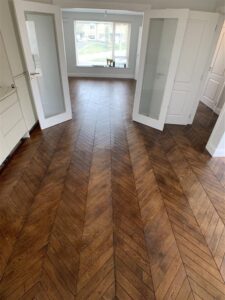
A beautiful chevron floor starts well before the first board goes down. It starts with the subfloor. Proper subfloor preparation is non-negotiable. The surface must be flat (within 3mm over a 1.8m span), dry, structurally sound, and free from contamination. Any deviation from this will show through the finished floor and compromise the pattern alignment.
The installation itself is a skilled, time-consuming process. A professional installer will establish the centreline of the room, set out the pattern dry before any adhesive is applied, and work outward from the centre to ensure the pattern is balanced relative to the room’s walls and features.
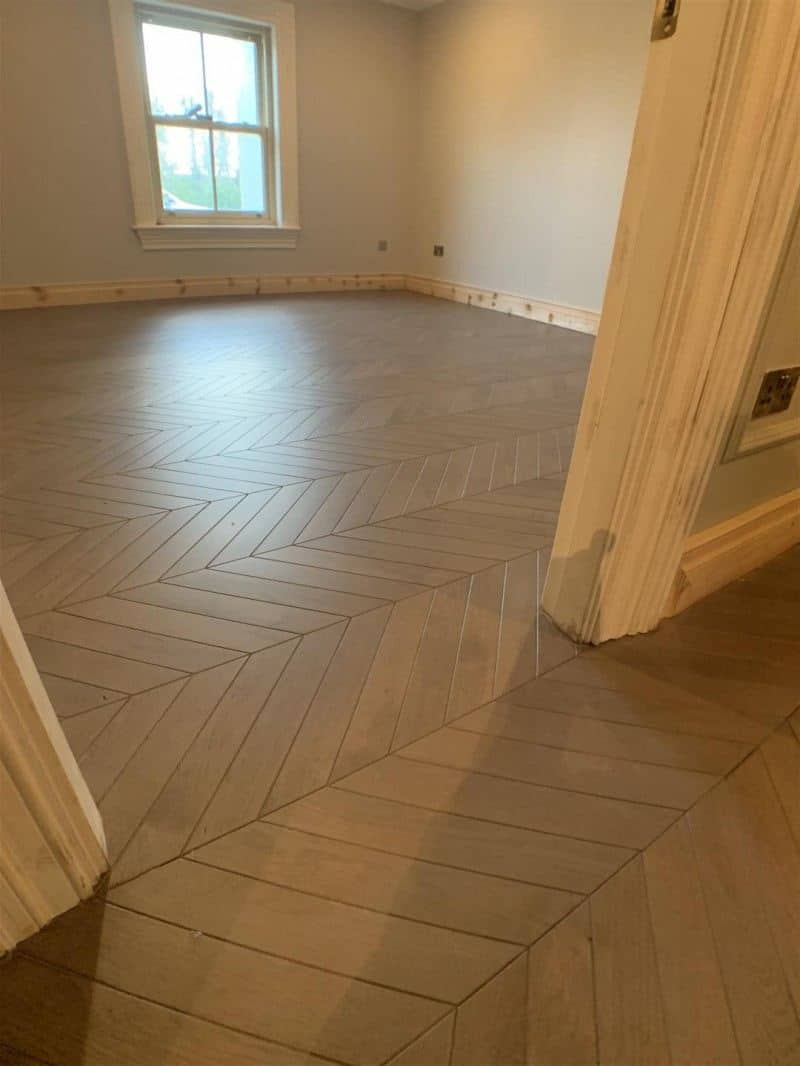
Cutting the angled ends requires precision (usually a mitre saw set to exact tolerances), and fitting around door frames, hearths, and curved walls requires experience and patience.
For a Dublin living room or kitchen, expect the installation to take one to two days for an experienced fitter. Larger or more complex spaces, like staircases, L-shaped rooms, and rooms with multiple doorways, will take longer. Allow additional time for subfloor preparation before the timber is laid.
Chevron Flooring in Ireland: Where to Buy
Quality chevron flooring is readily available across Ireland, but finding the right product at the right specification still requires guidance.
Not all chevron on the market is equal. The quality of the timber grade, the precision of the cuts, the thickness of the wear layer on engineered boards, and the quality of the factory finish all vary between suppliers.
MM Parquet supplies and fits premium chevron parquet flooring throughout Dublin, Leinster, and the surrounding counties. We work with a carefully selected range of manufacturers and source timber responsibly across a full range of species, tones, and formats.
Beyond supply, MM Parquet offers installation done by experienced parquet specialists. The difference in the finished result is significant.
Costs and Getting a Quote
Chevron flooring sits at the premium end of the timber flooring market, and pricing reflects the cost of precision-cut materials, professional installation, and subfloor preparation.
As a guide, material costs for engineered chevron oak flooring start from around €60–€80 per m². Premium grades, wider boards, and specialist species carry higher price points.
Installation is priced separately and varies based on room size, complexity, and subfloor condition.
The honest perspective: chevron flooring is an investment, not a commodity purchase. A specified, well-installed chevron floor will last decades with appropriate care, and it adds value (both aesthetic and financial) to a property. The cost per year over its lifetime is remarkably competitive when compared with cheaper alternatives that need replacing every ten years.
MM Parquet offers free, no-obligation consultations for homeowners across Dublin and Leinster. We’ll visit your home, assess the subfloor, discuss your brief, and provide a detailed, transparent quotation. No pressure or guesswork.
Ready to Transform Your Home with Chevron Flooring?
Few flooring choices reward you the way chevron does. It’s a pattern with centuries of heritage behind it, but it feels as current as anything in modern interior design.
It works in kitchens, hallways, living rooms, and bedrooms.
It suits pale Scandinavian palettes and rich, moody interiors equally well. And whether you choose classic chevron oak flooring, a contemporary grey chevron finish, or a dramatic dark timber, the result is a floor that earns its place as the centrepiece of a room.
The key is getting it right from the start: the right species, the right specification, the right preparation, and the right installation. That’s where MM Parquet comes in.
Ready to explore chevron flooring for your home? Contact MM Parquet today for a free consultation and quotation. We serve homeowners across Dublin and Leinster and would love to help you find the perfect floor.
Gallery