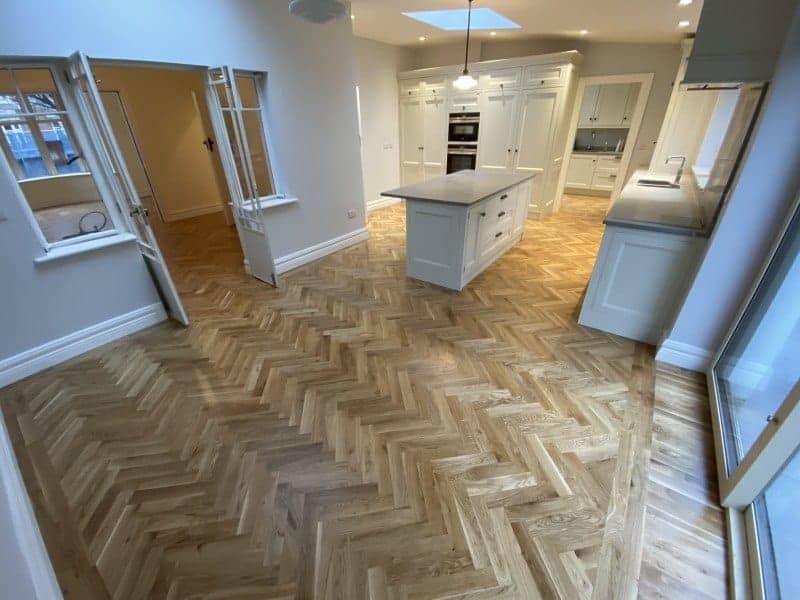
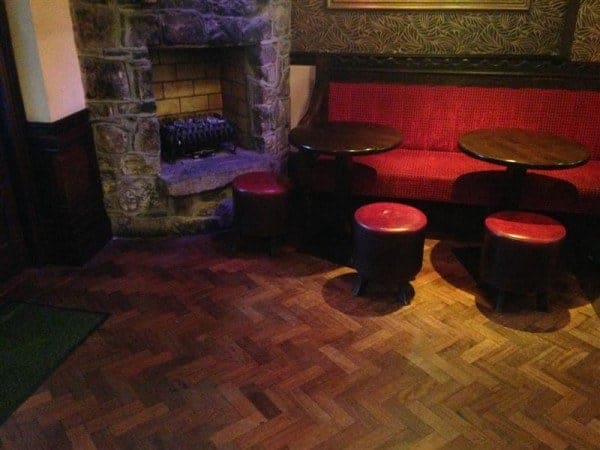
Herringbone Flooring for Kitchens, Hallways and Living Rooms: A Design Guide
Herringbone flooring definitely makes a statement.
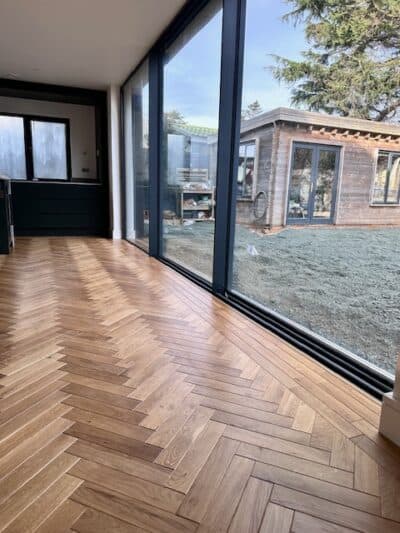
The moment you walk into a room with a beautifully laid herringbone floor, something registers: a sense of craft, intention, and a space that has been genuinely thought about.
It doesn’t matter whether you’re standing in a sleek open-plan kitchen in a Kildare new build or the hallway of a Victorian terrace in Ranelagh. Herringbone has that effect everywhere it goes.
What makes it so compelling is its ability to be many things at once. It’s traditional and contemporary. It’s bold and understated. It works in a grand entrance hall and a cosy bedroom with equal elegance.
The pattern itself, the interlocking V-shape, and those alternating blocks of grain add depth and movement to any surface it covers, transforming what could have been a purely functional element of a room into its defining feature.
At MM Parquet, herringbone flooring is one of the styles closest to our hearts.
We’ve been fitting herringbone wood floors across Dublin, Leinster, and the surrounding counties for over 35 years, in period properties and new builds, in kitchens, hallways, living rooms, and bedrooms, in natural oak and smoked finishes, and everything in between.
In this guide, we’ll show you how herringbone works across every room in the house, and how to make the right choices for your space.
What Makes Herringbone Flooring So Versatile?
Before we explore specific rooms, it’s worth understanding why herringbone flooring adapts so beautifully to a wide range of spaces and styles. It isn’t just good-looking. It’s also structurally clever.
The herringbone pattern is built on a 90-degree staggered arrangement of rectangular blocks, each one laid perpendicular to its neighbour, creating that signature zigzag flow across the floor.
The genius of it is the way it plays with light. Because adjacent blocks run in different directions, they reflect light differently: one catches it, the next absorbs it. This creates a constant, subtle interplay of tone and shadow across the surface. The floor appears to have depth and texture that a straight-laid plank cannot replicate.
This quality makes herringbone at home in period homes, where it echoes centuries of traditional craftsmanship, and in contemporary interiors, where its geometric precision feels crisp and intentional.
It’s a pattern that doesn’t belong to any single era or aesthetic. It belongs to rooms that are well considered, which is precisely why it suits so many of them.
Herringbone Flooring in the Kitchen
The kitchen has become the heart of the modern Irish home: open-plan, multi-functional, and the room that makes or breaks a property’s overall design.
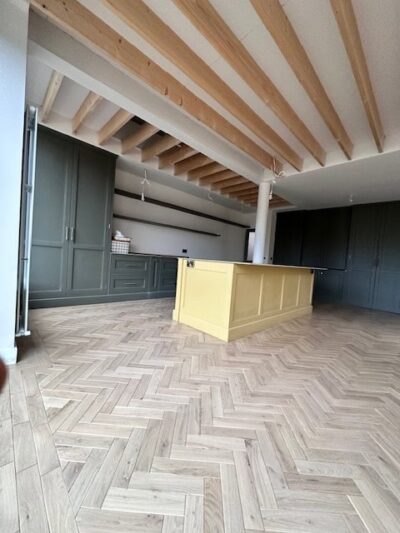
It makes sense, then, that the floor in this space deserves as much thought as the cabinetry or the worktops.
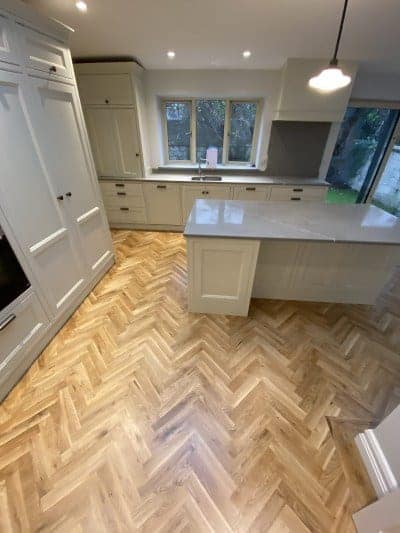
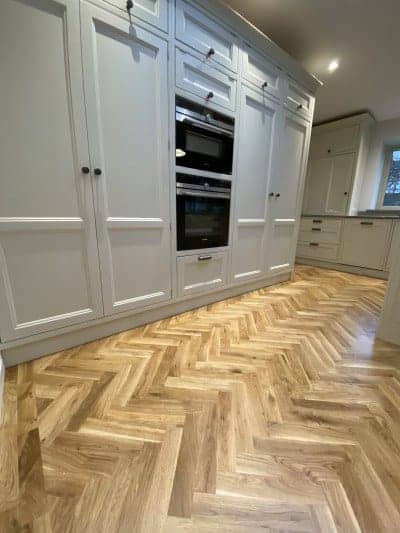
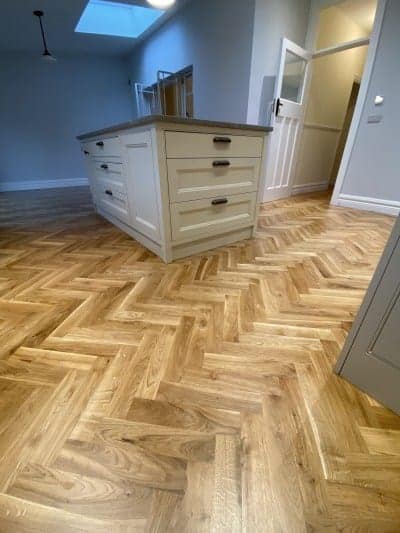
In an open-plan kitchen-diner, which is the dominant layout in new builds across Dublin and Leinster, herringbone flooring creates a visual continuity that ties the cooking, dining, and living zones together without a single rug or transition strip.
The pattern moves through the space, connecting it and giving it rhythm and flow. It’s both practical and beautiful, which is exactly what a kitchen floor needs to be.
Species and finish matter enormously in a kitchen context. Oak remains the most popular choice because its density and hardness make it well-suited to the demands of a high-traffic space.
For finish, a hard lacquer is the most practical option in a kitchen, providing a protective surface layer that handles moisture, spills, and daily wear better than an open oil finish. If the look of oil is what you’re after, then a hardwax oil is a strong compromise; it combines some of the natural appearance of oil with greater surface resistance.
Design pairing is where a herringbone kitchen floor really comes alive. Laid diagonally to the room, it creates a sense of expansiveness. Against pale shaker cabinetry, natural oak herringbone brings warmth that prevents the kitchen from feeling clinical. Against darker units, a grey or smoked herringbone floor creates a sophisticated contrast. The floor and the kitchen should be designed together, not as separate decisions.
One practical note: solid oak herringbone in a kitchen works well where underfloor heating is absent, and moisture is well managed. Where underfloor heating is present (common in Irish new builds), engineered herringbone is the more appropriate choice, offering the visual appeal of solid oak and the dimensional stability needed for heating systems.
Herringbone Flooring in the Hallway
Herringbone flooring in a hallway is one of the most impactful design decisions you can make in the entire house. It sets the tone for everything that follows. It tells your guests, before they’ve even taken their coat off, that this is a home where detail matters.
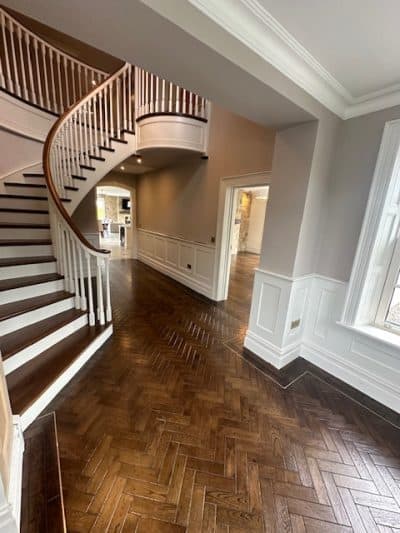
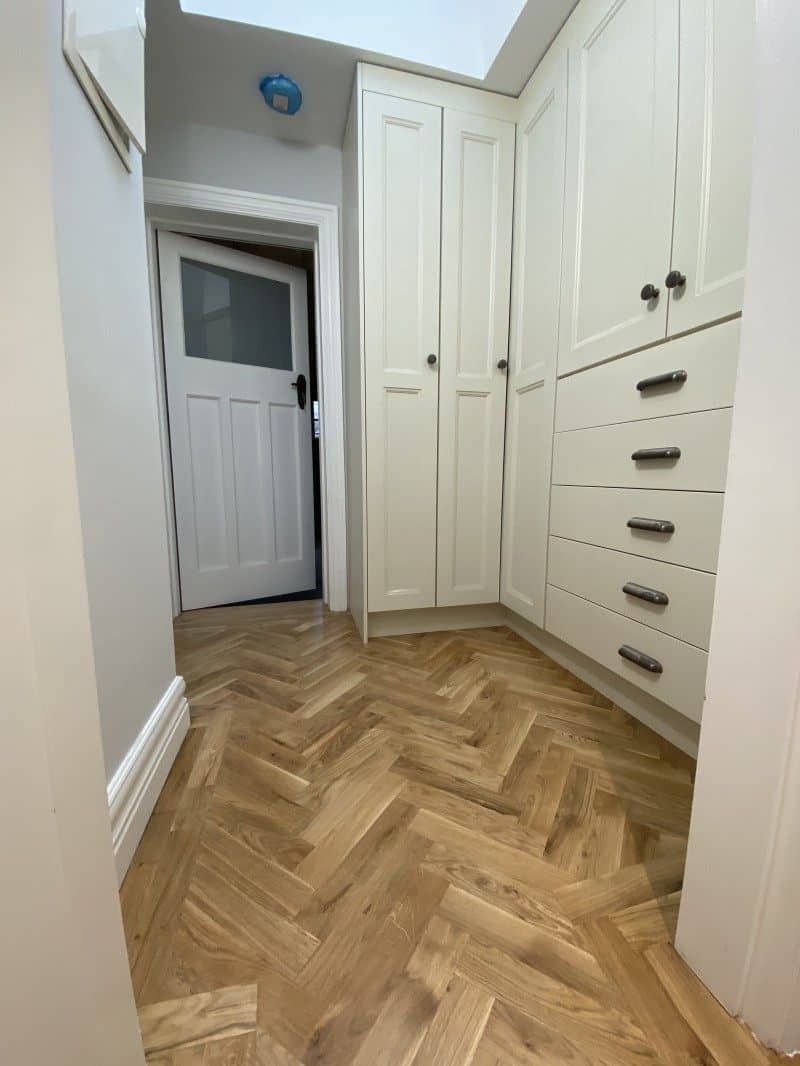
The directional quality of the herringbone pattern is especially well-suited to hallway geometry. Laid along the length of the hall, the pattern draws the eye forward, creating a sense of depth and elongation that makes even a narrow corridor feel more generous and purposeful. It leads you in. The floor becomes a path, not just a surface.
Practically, hallways demand the most from any floor. They’re the first point of contact for dirt, moisture, and the full force of daily foot traffic. Herringbone, with its tightly interlocked blocks and multiple finish options, handles this well. A hard lacquer finish is the most resilient choice for a hallway floor because it protects against grit, moisture, and the general wear that comes with being walked on by everyone who enters the house, every single day.
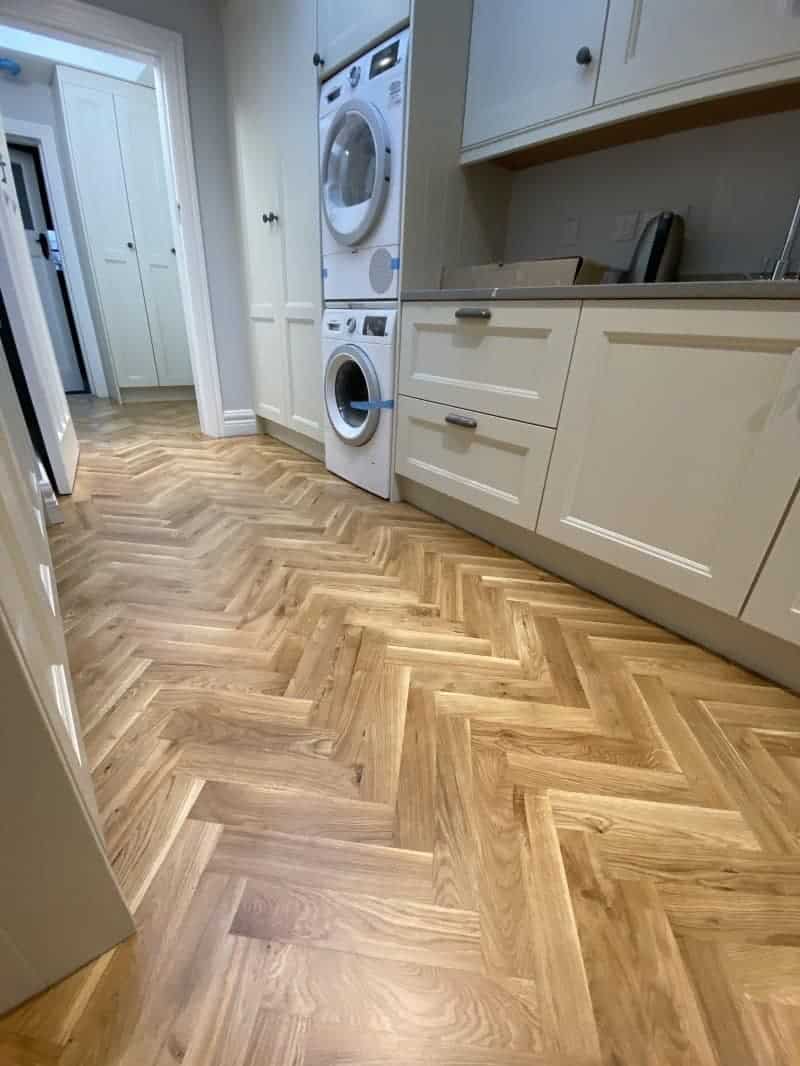
One of the most effective design moves for a hallway is continuing the herringbone floor into adjoining rooms, like the living room, kitchen, and study. This creates a seamless visual flow through the ground floor of the house that feels cohesive and intentional, as though the interior has been designed as a whole rather than room by room. It also makes the overall space feel larger.
Herringbone Flooring in Living Rooms and Bedrooms
In a living room, herringbone flooring moves from a design statement to true luxury.
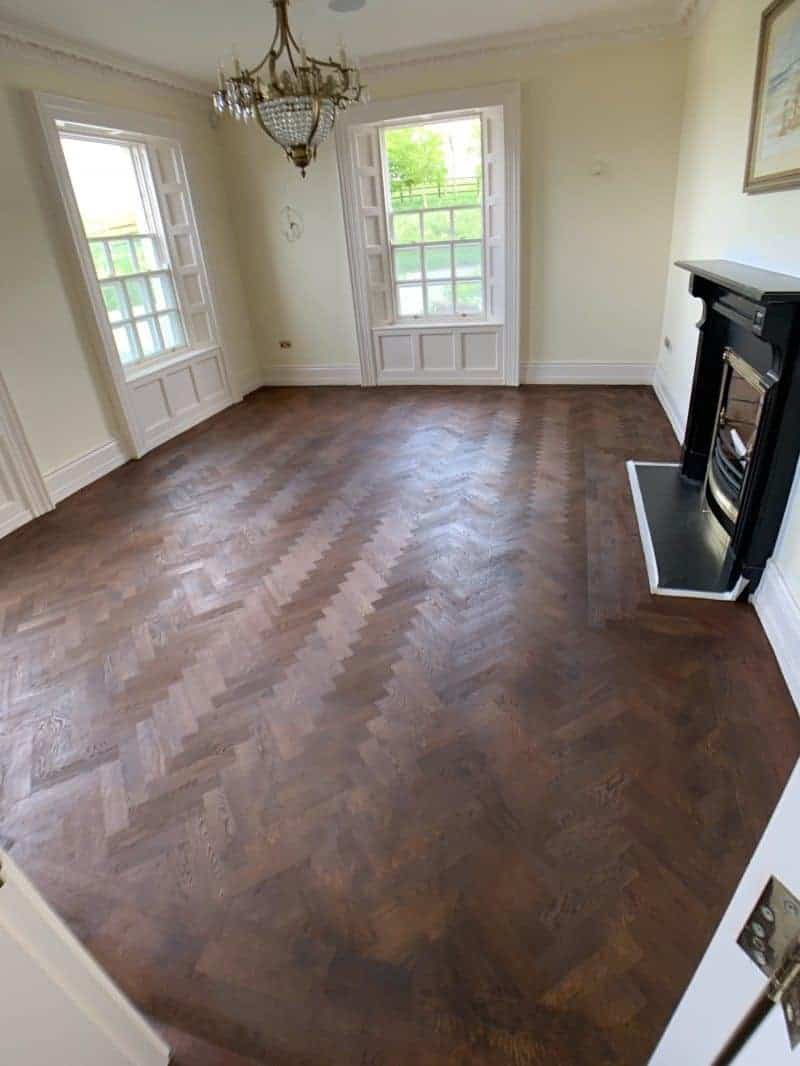
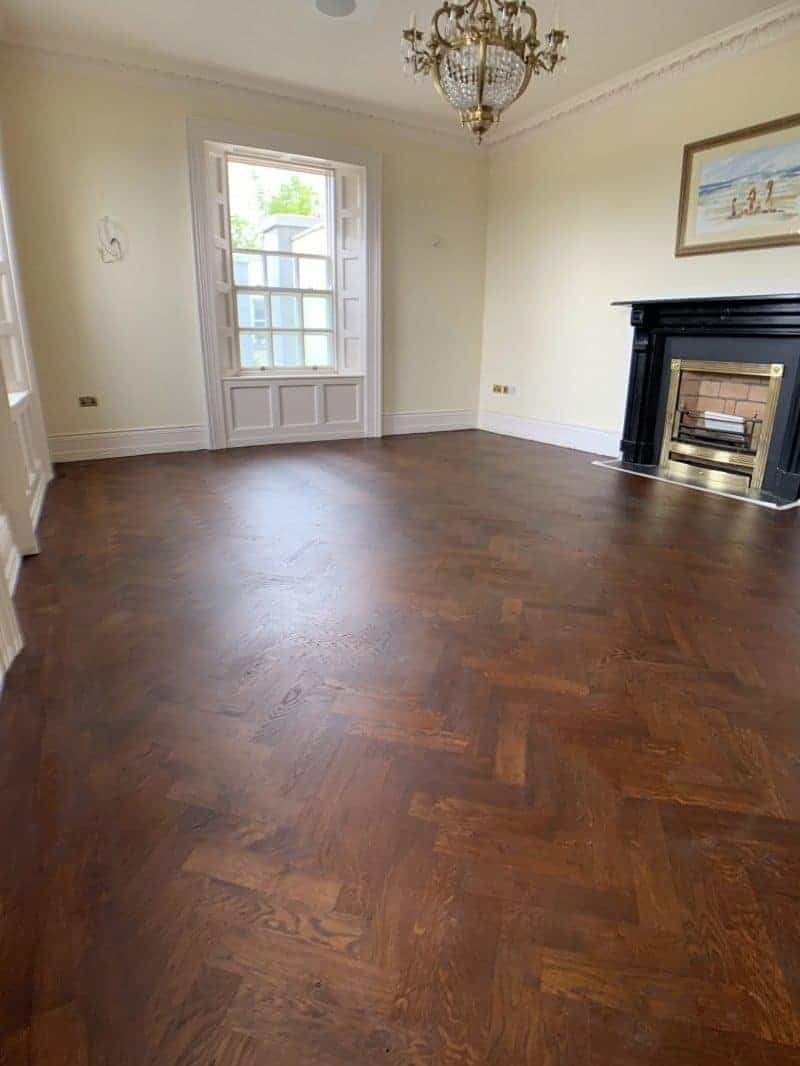
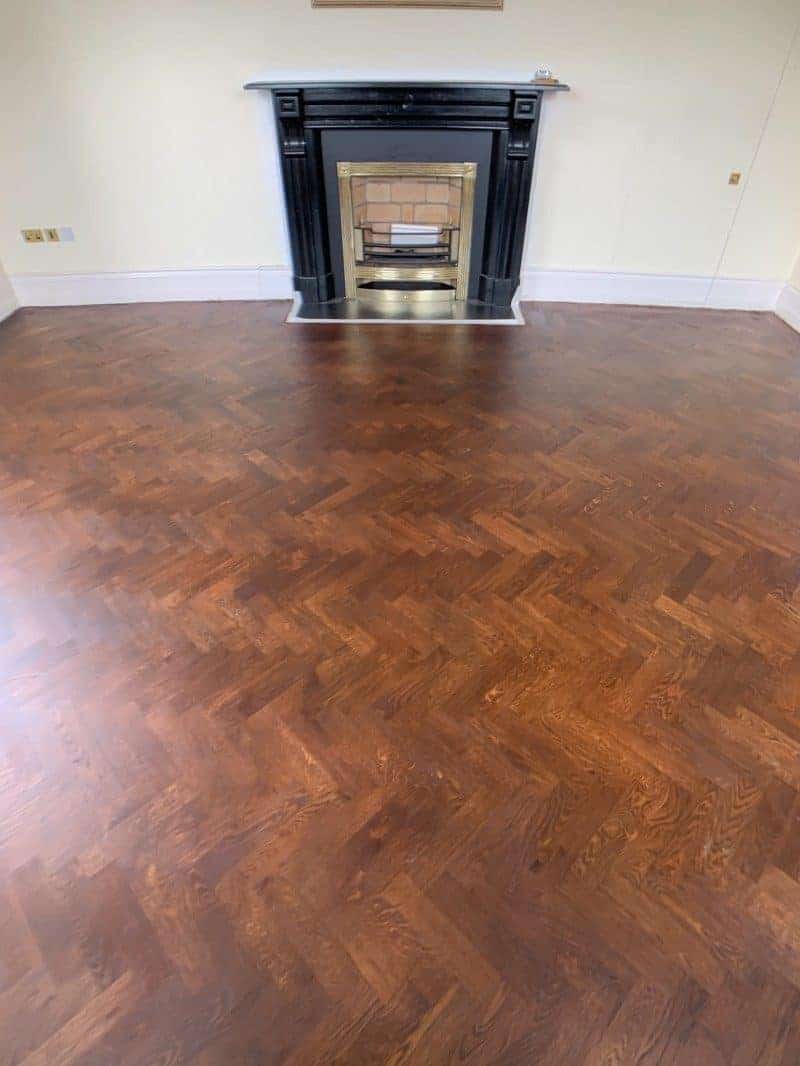
This is the room where the pattern has the space to truly breathe, where a larger block size can be used for dramatic effect, where the interplay of light across the alternating grain directions becomes mesmerising in the afternoon sun, and where the floor becomes as much a part of the room’s character as the furniture or the art on the walls.
Block size is an important consideration in living rooms. Larger blocks (wider and longer individual pieces) create a bolder, more graphic herringbone pattern that suits the scale of a generous room. Smaller, more traditional block sizes feel more refined and intricate. As a general principle, match the scale of the block to the scale of the room.
The herringbone bedroom floor is perhaps the most underappreciated application of the pattern. Bedrooms don’t get the design attention they deserve. And yet a herringbone floor in a bedroom, particularly in a lighter oak with a warm oil finish, creates a quality of warmth and calm that transforms the room. It’s quieter here than in a hallway or kitchen. More restful. The pattern adds interest without adding noise, which is exactly the right balance for a space designed for rest.
In both living rooms and bedrooms, the choice between solid and engineered herringbone often comes down to whether underfloor heating is present. Where it is, engineered is the practical answer. Where it isn’t, solid oak herringbone delivers an authenticity and refinishing potential that makes it the premium long-term choice.
Herringbone Floor with Border
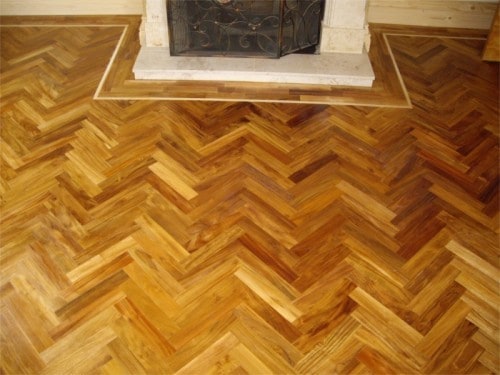
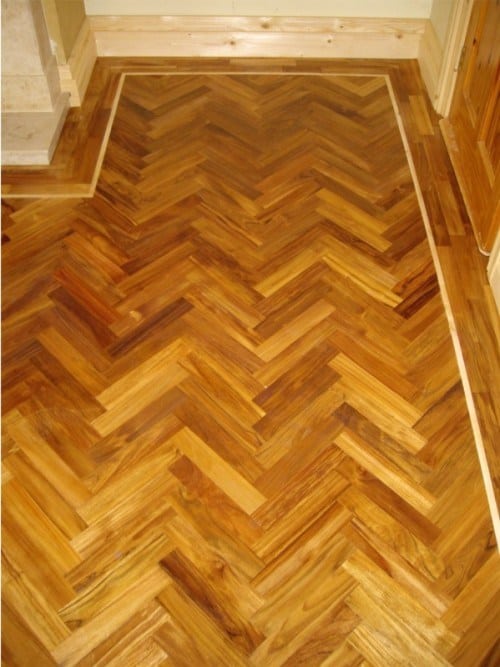
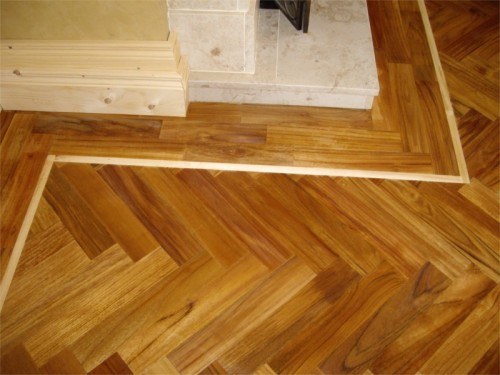
A border, which is a band of contrasting timber running around the perimeter of the herringbone field, does something architecturally powerful to a room.
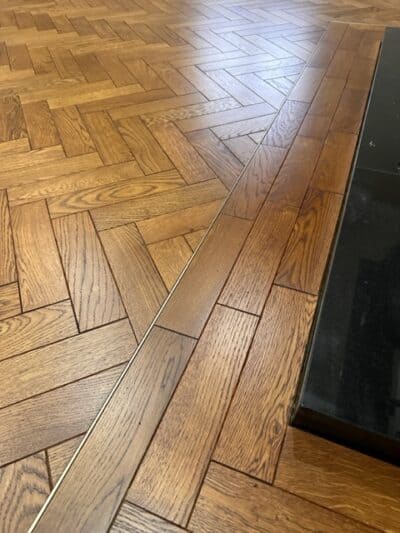
It frames the pattern, defines the space, and gives the floor a finished quality that elevates it from beautiful to extraordinary.
Think of it like a picture frame. The herringbone is the artwork: intricate, characterful, and full of movement. The border is what gives it an edge, what tells the eye where the composition begins and ends. Without it, the pattern runs to the wall. With it, the floor becomes a designed object in its own right.
Contrasting timber species are the most effective approach to borders. A natural oak herringbone field with a walnut border creates a rich, warm contrast that feels luxurious. A darker herringbone field with a lighter oak border gives a more graphic, contemporary result. At MM Parquet, designing borders with clients is one of our favourite parts of any project. The combinations are endless, and the results are always unique.
When to use a border: larger rooms where the herringbone field has the scale to justify a frame; period properties where the border echoes traditional interior architecture; formal spaces, like dining rooms, drawing rooms, and entrance halls, where the added detail is appropriate. In smaller rooms, a border can feel busy, though a slim feature line can work beautifully even there.
Large Herringbone Flooring
One of the most notable shifts in herringbone flooring over the past several years has been the move toward larger block sizes.
Large herringbone flooring uses wider, longer individual blocks to create a bolder version of the classic pattern.
Where traditional herringbone blocks might measure 70mm x 230mm, large-format herringbone can use blocks of 120mm x 600mm or beyond. The effect is dramatic. The pattern is more visible, more graphic, and has a contemporary confidence that suits the larger, more open-plan spaces of modern Irish homes perfectly.
The visual difference between small and large-block herringbone is substantial. Small blocks create a fine, intricate texture, almost like a woven fabric when viewed from a distance. Large blocks create something more architectural: each individual V-shape is clearly visible from across the room, and the floor has a presence that commands attention.
Best rooms for large herringbone: open-plan kitchen-diners, large living rooms, generous entrance halls, and commercial spaces. In smaller rooms, very large blocks can feel disproportionate. The pattern needs room to repeat enough times to read as a pattern rather than just a collection of large pieces.
Colour Options: Grey, Dark, and Natural Herringbone
Colour is where herringbone flooring becomes truly personal, and the range of options available today is wider and more sophisticated than ever.
Grey herringbone floors have been a dominant trend in Irish interiors for several years. A grey herringbone floor can be achieved through surface staining. However, the most sophisticated and durable results come from fuming or smoking the oak: a process that reacts with the timber’s natural tannins to produce a grey-brown tone that goes all the way through the wood rather than sitting on the surface. The result is a floor that looks aged and complex rather than simply painted.
Dark herringbone floors create a different atmosphere: rich, moody, and deeply luxurious. Walnut is the natural choice for a dark herringbone floor; its chocolate-brown tones and fine grain produce a premium result. Stained oak in darker tones and merbau, with its deep reddish-brown warmth, are strong alternatives. A dark herringbone floor against pale walls and light furniture creates one of the most striking interiors available in the Irish market today.
Natural oak tones remain timeless, and for good reason. The warm, honey-toned character of natural European oak suits the Irish home and the Irish light better than almost anything else. It’s the choice that ages most gracefully, that works with the widest range of interior palettes, and that never looks dated. If in doubt, natural oak is rarely the wrong answer.
Herringbone Flooring in Ireland: Local Trends
Herringbone flooring in Ireland has never been more popular, and the projects we’re working on at MM Parquet across Dublin and Leinster reflect a market that’s becoming increasingly sophisticated and design-conscious.
In Dublin’s period properties, the red-brick terraces of Ranelagh, Rathmines, Terenure, and Drumcondra, and the Georgian townhouses of the south inner city, herringbone flooring is a restoration choice as much as a design one.
These homes were built with character, and a tumbled-edge solid oak herringbone in a warm tone honours that character beautifully. Borders and feature strips are popular in period settings, adding a layer of interior architecture that feels historically sympathetic.
In new builds across Leinster, particularly in the growing commuter belt towns of Kildare, Meath, Wicklow, and Wexford, the brief is usually different. Larger rooms, open-plan layouts, underfloor heating, and a more contemporary aesthetic point towards engineered large-format herringbone, often in grey or smoked tones. Sometimes, clients add a simple border to define the living zone within an open-plan space.
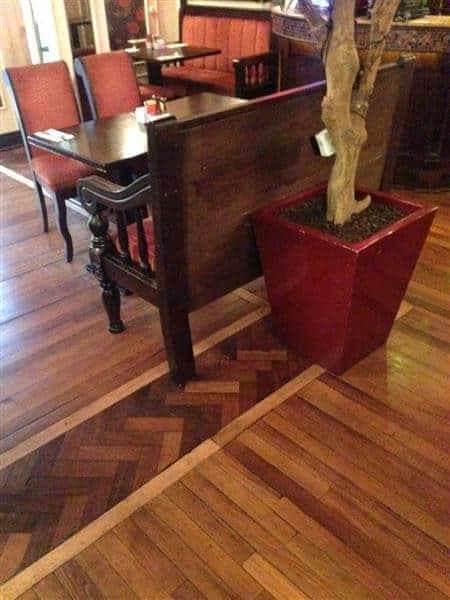
Commercial projects, like restaurants, boutique hotels, and high-end retail across Dublin, have embraced herringbone flooring as a signal of quality and considered design. It’s a pattern that communicates craft and attention to detail instantly, making it a powerful choice for any business that wants its physical space to reflect the quality of its offering.
Herringbone Flooring: Installation Considerations by Room
Different rooms present different installation challenges, and understanding them in advance helps avoid surprises during the project.
Subfloor preparation is the foundation of any herringbone installation, and the requirements are consistent regardless of the room. The subfloor must be flat, dry, and structurally sound. In kitchens and hallways, damp-proofing is especially important given the higher moisture exposure these rooms experience. In living rooms and bedrooms, the primary concern is flatness. Any unevenness will show through the herringbone blocks over time.
Pattern direction relative to the room is a decision that’s more important than most people realise. Laid along the length of a hallway, herringbone elongates and leads the eye. Laid at 45 degrees to the walls of a square room, it creates a sense of expansiveness. Your MM Parquet installer will advise on the optimal direction for the room before a single block is placed.
Thresholds and transitions between rooms require careful planning, particularly where herringbone meets a different floor surface or where the pattern needs to continue seamlessly from one room to the next. A well-planned threshold detail is invisible; a poorly planned one is immediately noticeable. It’s one of the many reasons professional installation matters as much as the product itself.
Costs: Herringbone Floor Installation Cost
Herringbone flooring is an investment in the material, the installation, and the long-term value it adds to your property.
Understanding what drives the cost helps you plan your project with confidence.
Room type and size are the primary variables. A large open-plan living space requires more material and more installation time than a hallway. Subfloor condition is a cost factor that’s easy to underestimate; remedial preparation work is essential and should always be budgeted for.
Timber species and finish affect material costs significantly: oak is the most accessible, walnut and smoked or fumed treatments command a premium. Pattern complexity, including borders, feature strips, or mixed species details, adds to the overall investment but delivers a visual return that far exceeds the additional cost.
Professional fitting is non-negotiable for herringbone, and its cost is always money well spent. The geometry of the pattern, the precision required at the perimeter, the layout planning, and the subfloor assessment: all of this requires experience. A herringbone floor fitted by an experienced specialist looks categorically different from one that isn’t.
Contact MM Parquet today for a detailed, no-obligation quote for herringbone flooring in your home.
Every Room Deserves Its Best Floor
Herringbone flooring is not a one-room pattern. It’s a whole-home philosophy: a commitment to craft,
character, and the kind of detail that makes a house feel well considered.
Whether it’s the drama of a dark herringbone floor in a formal dining room, the quiet warmth of natural oak in a bedroom, the practicality and beauty of a herringbone kitchen floor in an open-plan family space, or the timeless first impression of a herringbone flooring hallway, the pattern earns its place in every context.
At MM Parquet, we bring over 35 years of expertise in herringbone flooring across Dublin and Leinster, and to every project we take on. We understand the pattern, the timber, the rooms, and the homes, and we’d love to help you find the perfect herringbone floor for yours.
Book your free consultation with MM Parquet today.
MM Parquet — Crafting Exceptional Timber Floors Across Dublin, Leinster & Beyond for Over 35 Years.
Gallery